Why Your Prospects Say “Let Me Think About It”
Why Your Prospects Say “Let Me Think About It”
"The prospect who says 'Let me think about it' isn't giving you an objection—they're revealing a gap in your discovery process."
If you're hearing “Let me think about it” regularly during sales conversations, it's rarely because the prospect genuinely needs more time.
Most of the time, it's a polite way of saying:
“I'm not convinced.”
“I still have questions.”
“I don't see enough value.”
“This isn't a priority right now.”
“I don't feel confident making a decision.”
The good news? These issues can often be prevented long before you get to the close.
The Hidden Objections Behind "Let Me Think About It"
When a prospect asks for time to think, there is usually an unspoken concern sitting beneath the surface.
Common hidden objections include:
Concerns about cost or affordability
Uncertainty about ROI
Lack of trust
Fear of making the wrong decision
Concerns about implementation
Needing buy-in from other stakeholders
The mistake many salespeople make is trying to overcome these objections at the end of the conversation.
By then, it's often too late.
The best closers uncover objections early, not after the proposal has been presented.
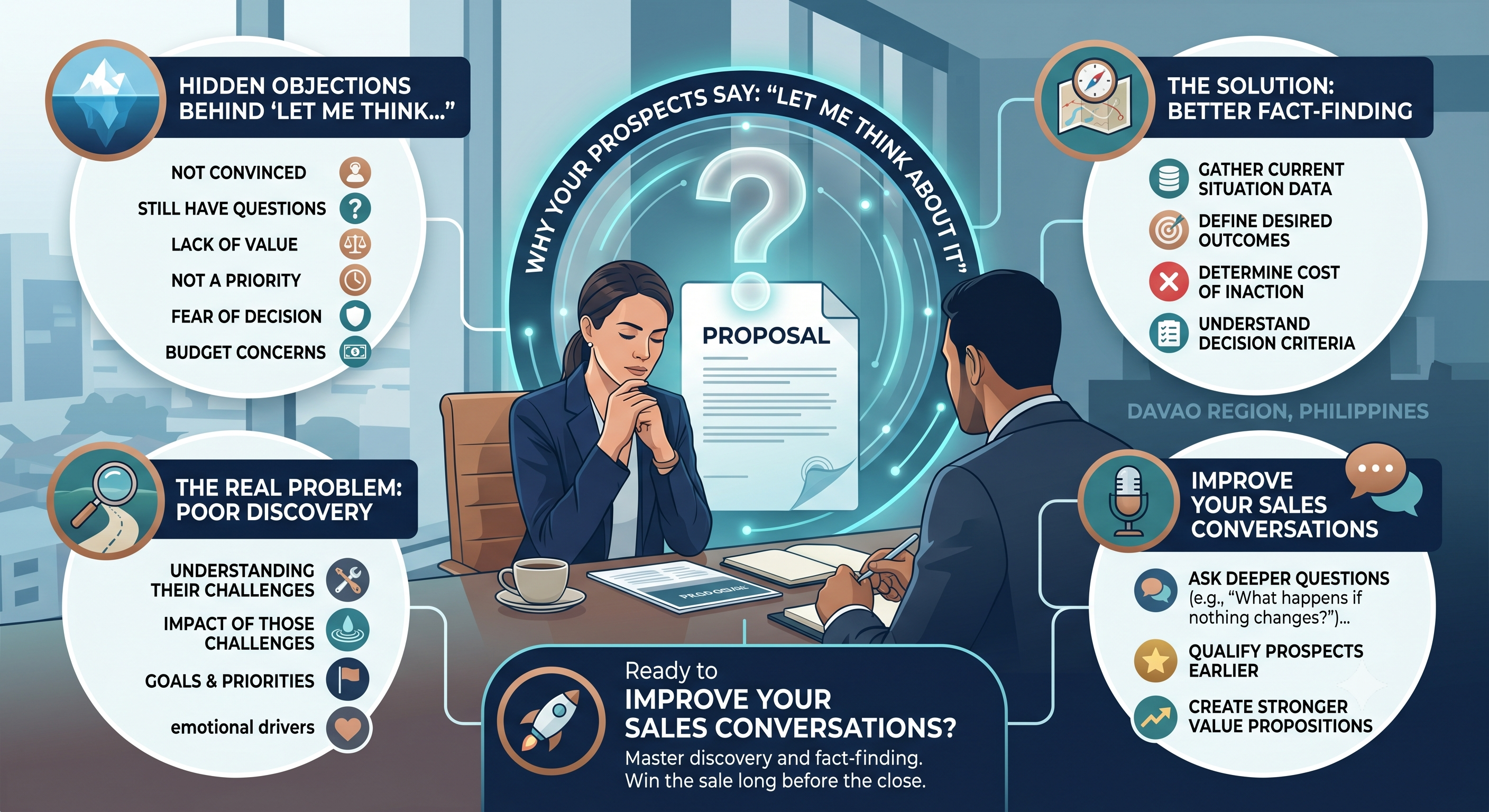
The Real Problem: Lack of Discovery
Most sales conversations fail during discovery, not during closing.
Many sales professionals spend too much time talking about their solution and not enough time understanding the prospect's situation.
Without proper discovery, you never fully understand:
Their current challenges
The impact of those challenges
Their goals and priorities
What's stopping them from moving forward
Why they need to solve the problem now
When discovery is shallow, prospects stay emotionally disconnected from the decision.
And disconnected prospects delay decisions.
Poor Qualification Creates Weak Closings
Not every prospect is ready, willing, or able to buy.
When qualification is skipped or rushed, salespeople often end up presenting solutions to people who:
Don't have a pressing problem
Don't have the budget
Don't have authority to make decisions
Don't see enough urgency
As a result, the conversation ends with:
"Sounds great. Let me think about it."
Strong qualification allows you to determine whether a prospect is genuinely a fit before investing significant time in the sales process.
It also helps you identify potential roadblocks before they become objections.
How Fact-Finding Changes Everything
Fact-finding is where sales conversations become transformational.
Instead of pitching, you're investigating.
Instead of persuading, you're uncovering.
Great fact-finding helps you discover:
The Current Situation
Where is the prospect today?
The Desired Outcome
Where do they want to be?
The Cost of Inaction
What happens if they do nothing?
Emotional Drivers
Why is solving this problem important to them?
Decision Criteria
What needs to happen for them to move forward?
When you gather this information effectively, your solution becomes the logical next step rather than a sales pitch.
The prospect starts connecting the dots themselves.
Better Questions Create Better Decisions
The quality of your sales conversations is determined by the quality of your questions.
Instead of asking surface-level questions, go deeper:
What prompted you to explore this now?
How is this issue impacting the business?
What happens if nothing changes over the next six months?
What would success look like?
Who else is involved in the decision-making process?
These questions uncover the truth behind the opportunity and help eliminate surprises later in the sales process.
Final Thoughts
"Let me think about it" is usually not a closing problem.
It's a discovery problem.
It's a qualification problem.
It's a fact-finding problem.
The better you understand your prospect, the less likely you'll hear delayed decision responses.
Focus less on closing techniques and more on uncovering the real challenges, motivations, and decision-making factors driving your prospect.
Because when prospects feel understood, see a clear path forward, and believe your solution solves a meaningful problem, they rarely need more time to think.
They simply make a decision.
Ready to Improve Your Sales Conversations?
If you want to uncover hidden objections earlier, qualify prospects more effectively, and close with greater confidence, start by mastering discovery and fact-finding.
The sale is won long before the closing question is asked.
Book a call a free STRATEGY call now!


