The Dead Horse Theory: Why Successful Leaders Know When to Dismount
"Structure isn't just about building things; it’s about having the clarity to dismantle what no longer serves the mission."
The Dead Horse Theory: Why Successful Leaders Know When to Dismount
There is an old Dakota Indian proverb that says: "When you discover that you are riding a dead horse, the best strategy is to dismount."
It sounds obvious, doesn't it? If the horse isn't moving, get off.
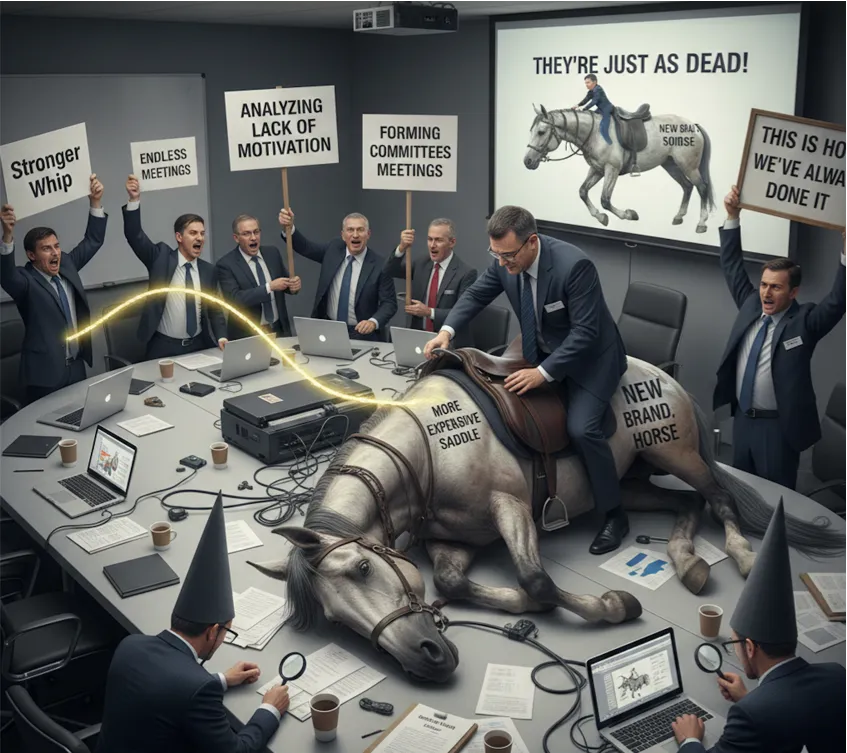
Yet, in the world of modern business, we rarely dismount. Instead, we try every "fix" in the book to avoid admitting the horse is gone. We call meetings to discuss the horse. We buy a more expensive saddle. We hire consultants to analyze the horse's "lack of motivation."
But the result remains the same: You aren't moving.
How We Try to “Revive” the Horse
In an SME or any growing organisation, a "dead horse" could be a product that no longer fits the market, a sales strategy that is out of date, or a system that has become so bloated it creates more work than it saves.
Instead of dismounting, many organisations do the opposite. They try to "innovate" their way around the fact that the horse isn't moving. You’ve likely seen these strategies in action:
Buying a stronger whip: Applying more pressure to the team, demanding more hours, and "grinding" harder to force a result that isn't coming.
Changing riders: Replacing leaders or managers every six months without ever fixing the root cause of the failure.
Saying “This is how we’ve always done it”: Clinging to tradition as if longevity is a substitute for effectiveness.
Hiring consultants: Bringing in outside "experts" to analyse the horse’s lack of movement instead of just deciding to get off.
Rebranding the dead horse: Repackaging the same failed idea with a new logo and a fresh pitch, hoping the market won't notice it's the same horse.
Forming committees: Discussing the horse endlessly in "strategy sessions" to avoid the discomfort of taking action.
Comparing with other dead horses: Normalising failure by saying, "Well, look at our competitors—their horse is just as dead as ours!"
The High Cost of Staying Mounted
The danger of the "Dead Horse" isn't just the lack of progress; it’s the opportunity cost. Every hour you spend trying to resuscitate a system that doesn't work is an hour you aren't spending on a new "live" horse—a new strategy, a better automation, or a fresh market.
Burnout isn't usually caused by working too hard; it’s caused by working hard on something that isn't yielding results. It’s the emotional exhaustion of kicking a horse that will never gallop again.
3 Signs It’s Time to Dismount
How do you know if you’re just in a "dip" or if the horse is actually dead? Ask yourself these three questions:
The Effort-to-Result Ratio: Does it take twice as much energy today to get half the results you got a year ago?
The "Start Over" Test: If you were starting your business from scratch today, would you choose this specific process/product/strategy? If the answer is "No," you’re only keeping it because of the Sunk Cost Fallacy.
The Market Response: Have you pivoted, tweaked, and adjusted, only to be met with the same silence from your customers?
The Courage to Dismount
Dismounting is painful. It requires admitting that a path you once believed in is no longer the right one. But the most successful CEOs aren't the ones who never fail; they are the ones who fail fast.
They realize that their ego is less important than their progress.
If you find yourself exhausted, frustrated, and stationary, take a look at what you’re riding. It might be time to step off, leave the dead horse behind, and find a new way forward.
Need 1:1 strategy advice? Book your call instantly.


